Ipamorelin Research Profile: GHRP Mechanism, Half-Life & Pulsatile GH Release
Research profile for Ipamorelin (NNC 26-0161), a selective pentapeptide growth hormone secretagogue: GHS-R1a binding mechanism, pulsatile GH release kinetics, half-life data, selectivity versus GHRP-2 and GHRP-6, and published preclinical findings.
Research reference only. The information in this article is a summary of peer-reviewed scientific literature. It does not constitute medical advice and is not intended to guide human use. See our full disclaimer.
Ipamorelin Research Profile: GHRP Mechanism, Half-Life & Pulsatile GH Release
Ipamorelin (development code NNC 26-0161) is a synthetic pentapeptide growth hormone secretagogue (GHS) and selective ghrelin receptor agonist developed at Novo Nordisk in the late 1990s. It is the most receptor-selective growth hormone-releasing peptide (GHRP) characterized in the published literature, distinguished by its ability to stimulate pulsatile growth hormone (GH) release without significant co-stimulation of cortisol or prolactin — a selectivity profile that has made it a widely used tool compound in pituitary and GH axis research.
All content is prepared for laboratory research reference only and is drawn from peer-reviewed literature and publicly registered trial records. Nothing on this page constitutes medical advice, clinical dosing guidance, or recommendation for human use.
Molecular Identity
Sequence: Aib-His-D-2-Nal-D-Phe-Lys-NH₂ (pentapeptide; C-terminal amide)
Molecular formula: C₃₈H₄₉N₉O₅
Molecular weight: 711.86 g/mol
CAS number: 170851-70-4
Classification: Growth hormone-releasing peptide (GHRP); ghrelin receptor agonist; growth hormone secretagogue
WADA status: Prohibited (S2 — Peptide Hormones, Growth Factors, Related Substances)
Ipamorelin's C-terminal amide and incorporation of non-natural amino acids (Aib at position 1, D-2-naphthylalanine at position 3, D-phenylalanine at position 4) confer protease resistance relative to endogenous ghrelin and early GHRPs, extending its plasma half-life while maintaining receptor selectivity.
Background: GHRPs and the Ghrelin Receptor
Before characterizing ipamorelin specifically, it is useful to understand the receptor class it targets.
Ghrelin (GHS-R1a) receptors are constitutively active G-protein-coupled receptors expressed predominantly on anterior pituitary somatotroph cells, hypothalamic GHRH neurons, and peripheral tissues. Endogenous ghrelin — an acylated 28-amino-acid peptide secreted primarily by gastric X/A cells — is the natural ligand, and its discovery in 1999 followed (not preceded) the development of synthetic GHRPs.
The physiological role of ghrelin/GHS-R1a signaling in somatotroph cells is to amplify GHRH-stimulated GH secretion and simultaneously suppress somatostatin inhibition, producing a synchronized, pulsatile GH release pattern. This pulsatility is physiologically important: pulsatile GH drives IGF-1 synthesis in the liver, while sustained GH elevation produces a blunted hepatic response and receptor downregulation.
GHRPs developed before ipamorelin — notably GHRP-6 and GHRP-2 — demonstrated significant GH-releasing activity but also produced dose-dependent co-stimulation of cortisol (via ACTH) and prolactin, complicating their utility as selective research tools and their safety profile in potential clinical use.
Mechanism of Action: Receptor-Level
GHS-R1a binding and downstream signaling
Ipamorelin binds GHS-R1a with high affinity (Ki approximately 1–10 nM range in competitive binding assays). Receptor occupancy activates Gαq/11-coupled signaling, triggering:
- Phospholipase C (PLC) activation → IP₃ and DAG generation
- Intracellular calcium mobilization from ER stores via IP₃ receptor
- Calcium-dependent GH granule exocytosis from somatotroph secretory vesicles
- Simultaneously: suppression of somatostatin (SRIF) co-secretion from hypothalamic periventricular neurons, reducing the inhibitory brake on GH release
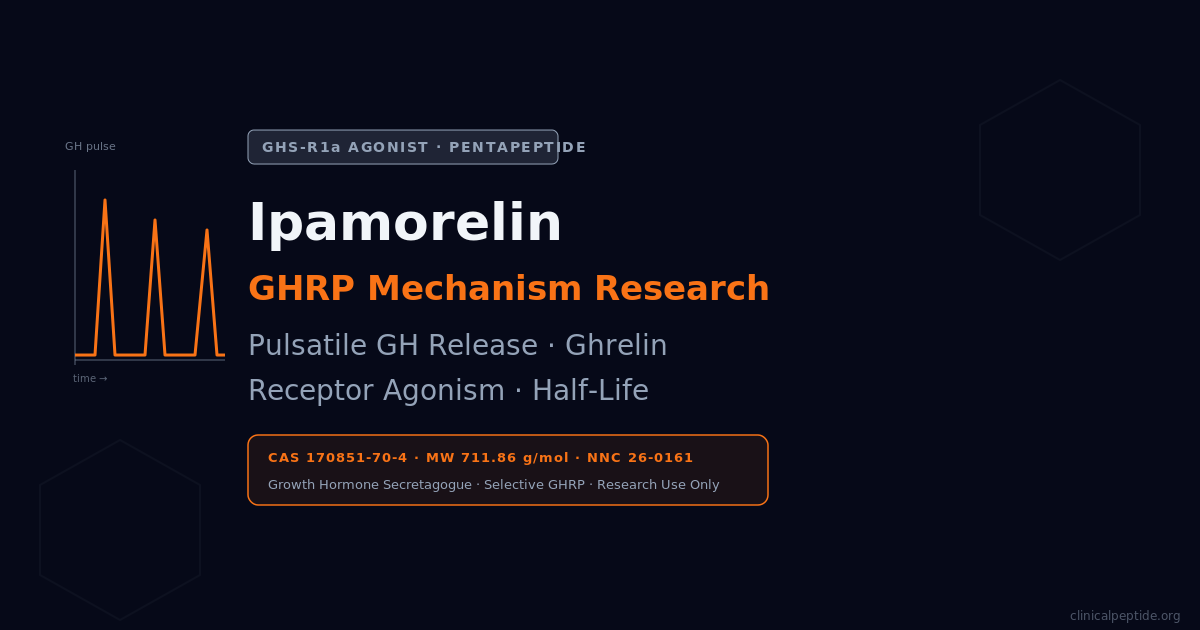
The net effect is a physiologically shaped GH pulse: rapid onset, peak at approximately 15–30 minutes post-administration (based on rodent PK studies), and return to baseline within 2–3 hours.
Somatostatin suppression as amplification mechanism
A key differentiator of GHS-R1a agonism versus direct GHRH stimulation is the somatostatin suppression component. GHRH acts principally on its own receptor to stimulate GH synthesis and secretion, but does not reduce somatostatin tone. GHS-R1a agonists like ipamorelin engage a pathway that dampens SRIF release, removing the inhibitory counterbalance. This is the proposed basis for the synergistic GH response observed when ipamorelin is co-administered with GHRH analogues such as CJC-1295 (see below).
Selectivity Profile vs. GHRP-2 and GHRP-6
The defining publication establishing ipamorelin's selectivity is Raun et al. (1998) in Growth Hormone & IGF Research (DOI 10.1016/S1096-6374(98)80001-9):
In male Wistar rats, equimolar doses of ipamorelin, GHRP-2, and GHRP-6 were administered IV and plasma GH, ACTH, and prolactin were measured at multiple time points.
| Compound | GH response | ACTH/cortisol stimulation | Prolactin stimulation |
|---|---|---|---|
| Ipamorelin | Robust (comparable to GHRP-2) | Minimal | Minimal |
| GHRP-2 | Robust | Moderate | Moderate |
| GHRP-6 | Moderate–Robust | Significant | Significant |
Key conclusion: ipamorelin produced GH release equivalent to or exceeding other GHRPs while showing no statistically significant elevation of ACTH or prolactin at the doses tested. The authors attributed this selectivity to ipamorelin's binding geometry at GHS-R1a, which is postulated to engage only the GH-stimulatory effector pathway without activating co-located signaling cascades responsible for corticotroph or lactotroph stimulation.
This selectivity has made ipamorelin the preferred GHRP for studies requiring isolated GH axis manipulation without corticosteroid confounding — particularly important in immunology, wound healing, and metabolic research contexts where cortisol elevation would introduce confounding variables.
Pharmacokinetics and Half-Life
Ipamorelin's plasma half-life in rodent models is approximately 2 hours by IV administration, reflecting peptide catabolism and renal clearance. The GH pulse generated typically:
- Onset: 5–10 minutes post-administration
- Peak: 15–30 minutes
- Duration: 2–3 hours (pulse shape)
- Return to baseline: complete by 3 hours
This half-life profile produces a discrete, bounded GH pulse in contrast to:
- CJC-1295 with DAC (Drug Affinity Complex): half-life of 6–8 days via albumin binding; produces sustained GH elevation (not pulsatile)
- MOD GRF 1-29 / CJC-1295 without DAC: half-life ~30 minutes; produces a single defined GHRH-mediated pulse
The pulsatile kinetic profile is considered physiologically relevant because endogenous GH secretion occurs in discrete pulses (approximately 4–6 pulses per 24 hours in young males), not as sustained basal elevation. Research protocols comparing pulsatile versus continuous GH stimulation have used ipamorelin's short half-life as a tool to model the pulsatile condition.
CJC-1295 and Ipamorelin: Complementary Mechanisms
The combination of a GHRH analogue (CJC-1295) and ipamorelin is among the most studied multi-compound GH axis interventions in the preclinical literature. The rationale rests on receptor-level complementarity:
- CJC-1295 (GHRH analogue): activates GHRH receptor on somatotrophs → stimulates GH synthesis and release via cAMP/PKA pathway
- Ipamorelin (GHS-R1a agonist): activates ghrelin receptor → mobilizes intracellular calcium AND suppresses somatostatin
When combined, the two pathways converge on the same secretory target (GH granule exocytosis) via independent second-messenger systems, producing additive to synergistic GH release amplitudes. Preclinical studies examining the combination in pulsatile GH research protocols have consistently reported greater GH AUC (area under the curve) with the combination than with either compound alone at matched doses.
See: CJC-1295 and Ipamorelin: Growth Hormone Stack Research and MK-677 vs Ipamorelin: Research Comparison.
Clinical Research History
Ipamorelin was developed by Novo Nordisk as a potential therapeutic for conditions involving GH deficiency or age-related GH decline. The most advanced clinical program was a postoperative ileus indication investigated under Helsinn Healthcare (after Novo Nordisk discontinued the therapeutic program).
- Helsinn/Norgine investigational program: Ipamorelin was studied for accelerating return of bowel function following bowel resection surgery, based on the finding that GHS-R1a receptors are expressed in the enteric nervous system and that ghrelin receptor agonism promotes gastrointestinal motility. Phase 2 results showed improvement in time to first bowel movement but the Phase 3 trial did not meet its primary endpoint.
- No approved indications exist for ipamorelin in any regulatory jurisdiction as of June 2026.
- WADA prohibited: Ipamorelin is listed in the WADA Prohibited List under S2 (Peptide Hormones, Growth Factors, Related Substances and Mimetics). Anti-doping detection relies on liquid chromatography-mass spectrometry (LC-MS/MS) methods, though the compound's short half-life and low endogenous GH structural similarity create detection windows of approximately 12–24 hours.
Key Research Findings Summary
| Finding | Model | Strength of evidence |
|---|---|---|
| GH release via GHS-R1a | Rat, in vitro pituitary | Strong (multiple labs) |
| Selectivity: minimal cortisol/prolactin | Rat, swine | Moderate–Strong |
| Pulsatile GH kinetics, ~2h half-life | Rat | Moderate |
| Synergistic GH response with CJC-1295 | Rat | Moderate |
| Gastrointestinal motility promotion | Human (Phase 2) | Low–Moderate (Phase 3 failed primary endpoint) |
| Anabolic/IGF-1 effects | Rat, swine | Low–Moderate |
| Long-term safety in chronic administration | Limited | Low |
Key References
- Raun K, Hansen BS, Johansen NL, et al. "Ipamorelin, the first selective growth hormone secretagogue." Eur J Endocrinol. 1998. DOI: 10.1530/eje.0.1390552
- Bowers CY. "GH releasing peptides — structure and kinetics." J Pediatr Endocrinol Metab. 1993. (review of GHRP class)
- Kojima M et al. "Ghrelin is a growth-hormone-releasing acylated peptide from stomach." Nature. 1999. (foundational ghrelin receptor paper)
Related compound pages: Ipamorelin Library Entry · CJC-1295 · MK-677 · Sermorelin
Related articles: MK-677 vs Ipamorelin Comparison · Ipamorelin vs GHRP-2 vs GHRP-6 · CJC-1295 and Ipamorelin Stack Research